Tuesday, July 9, 2013

Shlichus by Diffusion


I used to love being a Shabbos guest.

Who doesn't love being served a delicious home-made meal on a little island called "Shabbos" where all weekday stressors dissolve? When I first became observant, Shabbos was more about absorbing the benefits of the environment than it was about helping to create the environment. I just showed up, smiled politely, and made sure to express gratitude to my host.

Then, I went to seminary. For the first time, I wasn't a guest. I was a member. Each girl made the atmosphere by contributing with her unique qualities. We weren't taking anything- we were only giving and receiving. In my mind, that's how it should be. So when the semester ended, I returned home with a resolution. I was going to be more active, more influential. More vocal. Because I knew I had things to share- seminary helped me realize that. The validation, encouragement, and endless compliments I received from my peers regarding my writing and speaking abilities made it clear that I needed to stop being passive. I needed to use my talents to contribute to and elevate my surroundings.

But what I found in the community at home was a bit...disheartening. People weren't all that receptive to what I had to contribute. They just wanted to be my Shluchim, and I was just expected to blend in. To be a guest. They were the givers, I was the taker. And as much as I tried to break out of that mold, I felt like everyone kept forcing me back into it.

My neutral exterior would never have given away what I was feeling on the inside: Internally, I was stamping my feet on the hardwood floor and wildly waving my arms over my head, screaming, "Look! Look what I have to offer you!" I imagined that my hostess would glide across the room and plop a piece of potato kugel on my plate, her face an expressionless mask. "But look at what I have for you," she cooed. In my mind, an unspoken war was rippling between me and my shabbos hosts.

One week, I was granted refuge from my usual Shabbos routine. I caught a train out of Chicago to meet my family. We were vacationing in Door County, a sparsely populated haven of forests nestled on the shore of Wisconsin's peninsula. Around mincha time on Shabbos day, my family took a dinner reservation, whereupon I was left alone in the cabin. Naturally, I made a beeline for the rooftop porch. I spread out a blanket, read my Tehillim and hummed niggunim to a delighted audience of oak trees. I kind of felt like I was in a Baal Shem Tov story: Inhaling the fresh forest air, humbled by the dense silence of the woods. 

I've always possessed a childlike love for nature. Combine that with a cup of solitude, and you've got my ideal Shabbos afternoon. There is something magical about the forest. You can almost feel G-d's breath churning within the trees, His smile warming them into existence. He stretches His arm into their frail branches as if they were gloves. With a surge of G-dly energy and assurance, they grasp for the sky.
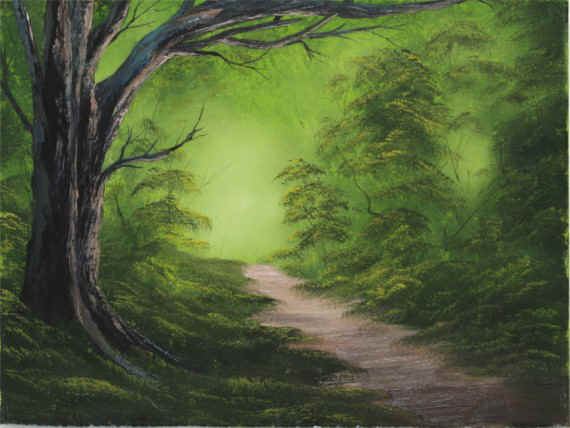
photo credit: smithsart.com

Nature is so uncontrived, so unassuming. It speaks only through being. It doesn't impose itself- it has no self. It's just a conveyor for G-dliness. It just is. We're always taught to contemplate nature, in all of its minute details, to arrive at an appreciation of G-d's oneness. But I feel like I don't even have to contemplate. I just feel G-d by diffusion. Just being in the presence of an existence that doesn't think it has an existence is more powerful than any mental contemplation I could do.

That's when I realized that the trees unknowingly personified the answer to my frustration.

Nature has tremendous power over the human psyche. It changes people- You retreat into the forest and come out with a whole new perspective. And yet- nature does nothing. Trees don't thresh their branches around and make a bunch of noise to get someone's attention. And that's precisely what makes them so effective and so magnetic. Nature just embodies the will of its creator. That's the most contagious quality imaginable. 

This is the level of essence. Of humility. It's what we all need to strive for. We're all just guests at G-d's table, endowed with a beautiful mission that we didn't do anything to deserve. Don't focus on the fact that YOU have something to share. First of all, we're not that great. Second, fixation on the self and its actualization distracts from the actualization of G-d's will. Instead, focus on WHAT you have to share and WHY it's important. 

Finally, to be a shliach or shlucha not only means to educate others explicitly, but to influence by diffusion: If your perspective is a G-dly one, it will transmit a clear message to those around you- even as you sit and enjoy your potato kugel.

Monday, July 8, 2013

Why Judaism is Pure Torture

People often think of religion as constrictive. As if some higher authority is towering over me, cuffing my hands behind my back and threatening that if I break free, I'll be hurled into the unforgiving grips of the underworld.

That's pretty scary, if you ask me. Not to mention inaccurate. But what's even scarier is the possibility that the opposite could be true:

Maybe, we're oppressing G-d.

Now, I know you're going to say that G-d is all-powerful and we can't affect Him, but forget about that for a minute.

Sometimes I wonder if G-d feels like He's in a strait jacket. After all, He's been dreaming and scheming for eternity but can't fulfill His plans for Moshiach. WE keep constricting Him, suffocating Him with our own agendas. All this craziness in the world is a manifestation of G-d's inner turmoil, His disturbed equilibrium. He's writhing like a snake suffering from a fit of seizures, desperately trying to express Himself! All He wants is to show Himself through His creations rather than hide behind them. 

Is G-d not the ultimate tortured artist?

And if so...where is our compassion?

Existence Under Construction

For me, writing isn't about putting my pen to paper and letting ideas flow out. My creative process is not nearly that glamorous. Rather, I'm usually hunched over my lap top at 1 am, my face contorted like a cauliflour as I study an invisible blob of ideas hovering over the keypad. I painstakingly organize them into a logical progression, extracting the necessary from the extraneous, the profound from the cliché, only to go back and rearrange my argument all over again. Insert a few phrases here, delete, delete. Rework an entire paragraph. Delete, delete, delete. Select all, delete.

Any segment of my writing that I deem to be of lesser value is acknowledged for barely a millisecond before it is discarded, only to be swallowed by the interweb where it is never to be fathomed again.

And then I have a final product, polished and shiny and intentional down to each syllabic rhythm. I forget the screw-ups even existed. All the errors fall away from my self-definition as swiftly as those unchosen words dissolve into cyberspace. I start to fool myself into thinking I'm a writer, when really I'm just a very determined mad scientist who persists through twelve hundred rounds of conceptual trial and error. This is the beauty (or downfall?) of technology: This instantaneous power of revision protects me from fixating on the parts of my work- and of myself- that just didn't make the cut.

It appears that technology, when employed as an artistic tool, can and does affect our self-esteem and self-definition. But is this a vice or a virtue?

Last week's parsha might provide some insight on this matter. Matos-Masei documented the Jews' travels out of Mitzrayim. And when I say "documented," I mean really documented. Every single resting place was included in the account, most of which appeared to serve as merely a means to an end. But the Torah acknowledges all 42 encampments. Torah gives them a voice, bringing to light their intrinsic value that could have easily gone overlooked. Each place serves a critical purpose by contributing to a larger process, the significance of which must not be ignored. 

Every detail of the journey is our Divine destiny just as much as is the ultimate destination.

This is precisely why I chose to first write this essay the old fashioned way: With pen and paper. All those mistakes will linger a bit longer in my mind as I clamp my teeth down on my pen and consider whether scribbling things out is worth the effort and the mess. That permanent smudge on the paper gives life to the journey, including the road not taken- but whose encounter paves the way for my eventual finished product. Every "mistake" speaks as eloquently as its revision. 

We're all just under construction, and for whatever reason G-d really likes it that way. If he didn't, he wouldn't keep sustaining us. The "I" of every moment is nurtured only by Divine intention. Therefore, true self-esteem cannot be contingent solely on the quality of your final draft or the filtered, perfect self you present to the outside. It requires embracing your PROCESS and your HUMANITY.

So make yourself vulnerable. 
Let people see your flaws. 
Give them something to rebuke you about. 

Because we're not computers. We're much more than just our output. 

Tuesday, July 2, 2013

Navigating the World Intuitively

At the close of my seminary semester, my classmates embarked on a mass pilgrimage to Crown Heights.

Equipped with their overpacked suitcases and Chassidus shiurim on their ipods, they gathered their innermost strength and resolved to begin anew in a frum community. They planted themselves in schools, high school dormitories, Chabad houses, Jewish educational organizations- anywhere they could hold an influential position devoted to cultivating the spiritual wellbeing of the Jewish people.

As for me? I traveled back to the Midwest, stayed in my parents' house for the summer, and then entered graduate school in a neighboring city.

I have to admit, I was a little jealous of my peers. It seemed they were in a nurturing environment that facilitated their Jewish development. I was halfway across the planet, totally unsure as to whether I belonged here and whether my academic pursuits contributed to my Divine service. But I had made a commitment to earn a viable degree. Furthermore, I believe G-d endowed me with certain unique qualities that must be employed. I've known for pretty much forever that I'm cut out to be a mental health professional. I would hate to squander that potential.

So, I made due with the situation. I traveled an hour by bus several times each week to attend maamer and sicha classes. I regularly "skype-farbrenged" with my friends from seminary. My new mantra became "A Chassid creates an environment."

But as much as I tried to remind myself that Shlichos can take place anywhere and building a Dirah Betachtonim is not limited to time or place, I was still a bit ambivalent regarding my participation in the graduate program. Not because I felt my studies opposed Yiddishkeit, but because I simply didn't know how to evaluate the philosophies being taught. Were the counseling approaches advancing or inhibiting the fulfillment of G-d's ultimate plan? Did Freud's theories parallel Chassidus, or oppose it? Each time I tried to understand the in's and out's of the various methodologies, the more frustrated I became. They certainly didn't oppose Torah, but they didn't seem to fit into it either.

I find that when I'm learning anything, I feel intellectually satisfied only when I can visualize how seemingly unrelated concepts parallel or contradict each other. But in this case, I couldn't seem to do that. In my mind, there was simply a lack of relationship. Or maybe, there was one so convoluted I couldn't formulate a clear mental image. I really didn't know. I was entirely distraught over the fact that I would be spending my professional life working toward something that I wasn't even sure reflected truth.

Then, like a flicker of sunlight in a painfully dreary afternoon, I had an experience that completely reoriented my thought process. It was one of those unforgettable "Aha!" moments when hashgacha pratis pounces on you like a hyperactive canine. You jolt into awakeness, greeted by it's sloppy grin. You can't help but feel that the universe is chuckling to itself, privately amused that you didn't see G-d's hand sooner.

Here's what happened: I came across a "My Encounter" segment from the weekly Living Torah episode. In this testimonial, a woman told a story of how she had written a letter to the Rebbe regarding a shidduch. As a sidenote, she mentioned that she was pursuing a Master's degree in Marriage and Family Counseling. She attested that this was just her "secular" job. Her "real" job- which she felt was her true calling- was being a Shlucha, assisting the Chabad House near her campus by hosting young women for shabbos. When the woman received the Rebbe's response to her letter, she noticed he made a correction to the phrase "secular job": The Rebbe had crossed out "secular" and wrote, "Healing the souls of children is Shlichus, too."

Upon hearing this, a surge of warmth radiated from my diaphragm up to my cheekbones, eliciting a contented smile. I now realized where I had erred in my thinking.

My mistake was thinking, period. I had been trying so desperately to determine whether these theories of counseling fit into my pre-existing ideological framework that I neglected to see the situation for what it truly was. I was so obsessed with how these methodologies work that I lost sight of why they are being implemented in the first place. The truth is that every counseling approach is intended to promote healing. In my work, I give people the tools to live in a meaningful way, create healthy relationships, and stretch beyond their comfort zone for the sake of their own and others' wellbeing. I don't explicitly talk about G-d unless they initiate that type of conversation- but certainly, healing their animal soul will relieve them of preoccupation with their own struggles and increase their receptivity to G-dliness in the long run.

The Rebbe didn't offer an argument for why or how counseling can be considered holy work. Look at what it does- it heals people. That's good. Period. It doesn't always take a genius to distinguish between truth and falsehood, right and wrong. Sometimes, you have to take a step back and base your judgment on your gut feeling. Stop analyzing for a second. Stop intellectualizing. There are times when you can scan a situation intuitively and just KNOW. Intellect is a powerful and beautiful tool- but sometimes we need to release ourselves from its grip. G-d gave us truth detectors. Let's use them. 

Finally, I came to accept that uncertainty is healthy. I know my friends in Crown Heights experience this feeling to the same extent as I do- no one is immune. But it's my energizer bunny. It drives my questions, it propels me across town to that late-night Chassidus class, and most importantly: It adds depth and complexity to my relationship with G-d.

There's a lot I still don't understand, but I like to think I'm moving in the right direction. To my friends' disappointment, I won't be moving to Crown Heights just yet. But for now, I'm okay with that. I have a lot of important work to do right where I am.

Sunday, June 30, 2013

The Feminine Experience

Growing up, I had an unabashedly negative association with femininity. I stubbornly refused to wear dresses if not for special occasions, I shyed away from "girly" hugs with my playmates, and I arm-wrestled (and beat) all the 7th-grade boys at every single bar and bat mitzvah party. My mother had to convince me to wear make-up when I was 15- you get the picture. It wasn't that "female" conventions didn't appeal to me, it was more that I was embarassed by what I thought they represented. In my mind, femininity was associated with weakness, immaturity, superficiality, lack of intelligence, and being overly driven by emotion. From a young age, I wanted no part in any of that.


As I matured, I naturally wanted to explore my femininity more, but I didn't have an identifiable channel through which to do that. It was only when I started to integrate Judaism into my life that I was confronted with my "unique" status as a woman, being that my roles and responsibilities as a Jew stood in stark juxtaposition to the men's. I began to seriously contemplate what it means to be a woman.

For the most part, I found clarity and comfort in the Jewish community. I felt that I had developed a deeper sense of who I was through my relationship with G-d, I loved the joyful atmosphere at the shabbos tables I visited, and I found truth in living for something beyond myself.

But there was something itching just under the surface of my complacent exterior that I myself wasn't even aware of until the initial allure of observant life wore off. I couldn't quite pinpoint where my discomfort had originated until a conversation with one of my close friends allowed these concerns to surface. She was dissatisfied with her standing as woman in the observant community.

"I just don't feel connected to anything higher than the mundane world I interact with," my friend confessed. "Of course I believe in G-d, but men have so many more opportunities to feel spiritual in their day to day lives."

In a way, my friend was right. Men do have more clear-cut opportunities, simply by nature of the fact that halacha obligates them in the performance of time-bound mitzvos. They are required to wrap tefillin, daven with a minyan, and learn Torah on a consistent schedule. Furthermore, the infrastructure of the Jewish community is designed to support these activities.

Women often respond to this seemingly unbalanced dynamic by emphasizing the higher spiritual quality of the feminine soul. We are taught that our souls more closely resemble G-dly attributes and naturally gravitate toward spirituality. We are supposedly less inclined to seek corruption through the material world, but rather possess a natural sensitivity to physicality's potential for elevation. Therefore, we don't need mitzvos to keep us in line.

Although I had always appreciated the beauty of this explanation, I wasn't completely satisfied with it. I certainly didn't feel like I was more spiritual than my male counterparts. I felt that only by furthering my learning and experiences could I arrive at an understanding of my femininity with which I felt comfortable. As a result, my thirst for learning Torah and my interest in immersing myself in Jewish environments only intensified.

As a part of this process, I decided to spend a year in seminary at Mayanot Institute of Jewish Studies in Jerusalem. What I witnessed at Mayanot was completely unexpected- and truly transformative.

The first phenomenon I noticed was that many girls arrived to the program wearing pants or shorts. Then, realizing they were in a "religious" environment, they hastily scoured their luggage for clothing they felt was more suited for a seminary. The next morning following Chassidus class, Rabbi Levinger made a point of individually approaching each girl who had undergone this overnight transformation. One by one, he shot them down for their choice to conform.

"Avodas Hashem (divine service) should come from within," he urged. "Not because anyone else is doing it. Not because of the environment. Not even because halacha says so. Only when halacha starts to mean something to you should you hold yourself to those standards."

It didn't take me long to realize that the emphasis on "internalizing" Torah teachings infiltrated every aspect of the program. We learned Talmud to internalize G-dly wisdom. We sang niggunim to increase our receptivity to G-dly concepts in order that they become internalized. The greatest surprise to me was that we were rarely taught about the Lubavitcher Rebbe in an explicit manner. If we wanted to explore a uniquely "Chabad" approach to Judaism, it would come from our own personal, internal desire to do so.

More and more, I began to understand the reasoning behind this philosophy and how it related to my identity as a Jewish woman. My friend was right when she noted that halacha demands less of us in our day to day life. But it is precisely because of this that we are alloted an even greater opportunity: to demand more of ourselves. The community infrastructure may appear to favor men- but discreetly built into this system is the possibility for us to create our own internal infrastructure- one that is infused with the deeply held values that we have consciously chosen as our own. If I choose to learn Chassidus at a set time each day, it is because I have searched within myself and decided it is truly important to me. It wouldn't be merely because the community expects it from me.

There is a pasuk in Tehillim that states, "All the glory of the King's daughter is within." I never understood what this meant until recently. In addition to the literal implication that women draw spiritual strength from their inner conviction, the term "daughter" often refers to the entire Jewish people. As women, we are the "glory" of our people, demonstrating to the congregation what it means to ignite spirituality from the inside. 

photo credit: www.smith.edu/studyabroad
Furthermore, this strength of conviction can also grant us the wisdom to know when we should, in fact, challenge the community norms. This week's parsha beautifully exemplified the Jewish woman at her best. Machla, Noah, Hoglah, Milcah, and Tirtzah advocated for a portion of the inheritance of Eretz Yisroel. They believed in this calling with such passion, to the extent that they challenged the law conveyed by Moshe at Sinai! There was no requirement for them to do so- but they felt- they knew- it was right. Their opposition came not from a place of disrespect for Torah, but because they realized that alloting women a portion of the land was indeed a true expression of Torah that had not yet been revealed to the world.

You might be wondering why all the spiritual exertion I'm talking about is necessary if we are, in fact, already "holy" enough. How does the "lofty" level of our soul fit into all of this?

Well, let's be realistic here. Maybe we are on a higher spiritual level- but right now, we live in bodies. We're still constrained by our bodily limitations, our human failings, our desires that lead us astray. Our neshama's perspective has not yet permeated the fleshy sinews of our human brains. Actualizing our potential to live on our "soul level" requires conscious, consistent exertion. Which is why as women, I believe we should learn Torah (not just attend shiurim, but actually learn), take the initiative to organize our own farbrengens, and embrace any opportunity we can to enhance our spiritual consciousness. If we make the effort, maybe we can get in touch with that "higher" part of ourselves.

Being a woman isn't easy. You have to search within yourself- a lot. But based on what I've experienced, there's a lot more to womanhood than the silly personifications of society. The more I  explore my femininity, the more I realize that stereotypes such as superficiality and intellectual repression are the polar opposite of what G-d wants from me. I've also realized that what G-d does want from me may not be so clear just by consulting halacha. There is a realm of observance that lies within the boundaries of halacha, but expresses itself implicitly- rather than explicitly- to those who search for it.

We may not be granted as many obvious opportunities to engage in "religious" practices- but what that means is we get to create opportunities. We get to be innovators, initiators, and advocates of internal spirituality. 

I couldn't be any happier with my portion. :)

Friday, June 28, 2013

Shedding the BT Label

Last fall, I moved out of my parents’ house. I told my mother she could have some of my kosher kitchenware- the items designated “dairy," to be specific- because I no longer planned to use them. Being that my family eats milk and meat together, I knew that the dishes would not remain kosher once my mom cooked with them. Instead, I would rely on my “meat" dishes anytime I came home to visit.

When I came home for Thanksgiving, I found that my mother had cooked not only with the dairy dishes, but the meat ones as well. As a result, I no longer had a means of preparing a meal for myself.

I was frustrated. Even though I knew it had been a simple misunderstanding, somewhere in my mind I was thinking, “Life would be SO much easier if my family would just keep kosher. Furthermore, their lack of consciousness in dealing with physicality is utterly intolerable."

Okay, I’m not actually that high and mighty. I’m just trying to make a point.

My point is that we’ve all had those moments. Those who identify as Baal Teshuvas can almost certainly relate to this experience. Even for those who don’t, you’ve probably butted heads with your parents at some point concerning some difference in ideology.

It used to be that many of us were unconditionally accepting of the diverse worldviews held by our friends and family. After all, today’s world is all about banishing “intolerance." The value of assimilating the “other" into mainstream society has acquired a godlike appeal.

But suddenly, you become a BT and everything changes. You become a proponent of intolerance. Now, truth is truth, pluralism is ridiculous, and right and wrong are clearly defined. Most importantly, people who don’t believe in the truth better start believing in it!

Let me pose a question: Why do we CARE so much that other people see things like we do? Why does it matter?

You might say, “Only when everyone sees the truth will Moshiach come." If that’s your real answer, wonderful. But I don’t think that’s an honest self-appraisal. Alternatively, you could answer, “It would be so much more convenient if my parents would just keep kosher." Ok, getting closer. But really, you and I care because we want validation- emotional, intellectual, whatever. It’s hard to be the odd one out in the place we’re supposed to call “home," the place we want to consider our comfort zone. So we need reinforcement.

But why? Why can’t we just know what we know, relishing in our private access to truth without enforcing our standards on others?

I guess it’s because we don’t know what we know. I might, to some degree, understand G-d on an intellectual level. I know the entire world is actually an expression of G-d. But I don’t really know Him yet. I don’t look at my kitchen table and see G-dliness radiating from my broccoli. And for some weird reason, I think that confirmation of G-d- from someone who is just as blind as me- is going to sharpen my vision. And dissent will weaken it.

Not only do I seek external validation due to feeling out of place in my home, but because I feel out of place in my observance. Who am I to be doing mitzvos, serving the Almighty? I’m not worthy of that. Every time I visit my parents, I’m reminded that I’m just the same as them. That I’m human, just like they are. And that scares me.

Crazy.

Know why that’s crazy? Because I call myself “religious" and they don’t, but at the end of the day, we’re both blind.

Really, we’re all in the same boat. We ALL struggle to see G-d in a world seemingly devoid of Him. Listen up, self-proclaimed BT’s! There is no “us" and “them." The dichotomy of “frum Jew" vs. “unenlightened secular world" is an illusion.

But our blindness is not the only quality that unites us. More importantly, we are bound together as one people because of our potential for vision. Our souls contain a spark of the Almighty, and with that comes G-dly knowledge. Our inward journeys will eventually lead us to the same place, a place of utter clarity that exists independent of circumstance. We're united in our flawed humanity just as we are in our G-dly perfection. We're all swept up in a single current, flowing toward a reality in which oneness will reign.

So if we’re going to be intolerant of something, let’s turn that frustrated emotion into something constructive. Perhaps, we can focus our energies on the underlying issue rather than its symptoms: We can refuse to tolerate the distance between G-d and us.

Let’s protest the fact that since the destruction of the Beis Hamikdash, G-d’s presence is no longer revealed to us. That children and parents can’t respect each other. That Jewish communities live in isolation from one another, overcome by “politics" and divisive labels.

The Beis Hamikdash was destroyed because people weren’t being tolerant or kind toward one another. The Jewish people committed “bloodshed": they spoke negatively about each other to such an extent that the sages equated it with murder. They couldn’t love one another, hopelessly divided by their differences. Or rather, their perceived differences.

Three weeks from now is Tisha b’Av. We should, of course, attempt to generate loving and respectful feelings toward one another. We should mend our relationships while still holding fast to the Torah perspective.

But that’s only half the battle. My proposal is that we not only transform our intolerance toward each other into love and kindness, but even find a proper channel for our intolerance. I tend to think every human quality can be directed toward good, so why should this be an exception? G-d implanted this emotion in us for a reason. We can and should be intolerant- in the right way.

As such, let’s challenge G-d’s choice to distance Himself from us. To create humans who view reality so, so differently than one another and than He does. That HIS perspective- as conveyed through Torah- is sometimes so incomprehensible to us. Let’s refuse to be satisfied until this irreconcilable distance is bridged. We’re all trying to coax G-d’s presence into this broken world, one act of kindness at a time. If we choose, we can all be on the same side.

Finally, let’s stop lamenting over the fact that we don’t feel comfortable in our parents’ kitchens. While we’re bickering over our petty dishes, there’s a larger issue at hand: G-d can’t yet feel at home in the world He created. And we can’t feel at home with G-d.

I refuse to tolerate that.

So, Mom and Dad- Are you with me on this one?

Finding my Truth

I'd like to share an essay that I wrote right after Gimmel Tammuz. Although it was posted on my other blog, I feel it belongs here too because it symbolizes a personal turning point. The direction that my writing takes from this point forward will reflect many of the realizations that I documented in that post. So here it is:

I was recently confronted with a question of belief.

My sister and I were lazing around one afternoon in July. It was one of those sourly unremarkable days that requires some sort of whimsical endeavor just to keep us from melting into monochromatic blobs. So we hoisted ourselves up onto the nearly ancient swing set that stood in our backyard, its structure still poised as ever and not even that splintery. Just as we had done as children, we positioned ourselves side by side with our legs dangling from the ledge of the lower platform. We sat tracing figure eights in those pesky patches of dirt beneath our sneakers, interspersedly philosophizing about everything and nothing like we always do.

Sharlotte furrowed her brow. “What do you think is the purpose of life?" She kneaded a clump of earth with her shoe, haphazardly dislodging it from its habitat. “And how do you fulfill it by, like, doing mitzvos and stuff?"

I beamed. “That’s a very important question," I remarked dispassionately, in an effort to conceal the admiration I felt toward this precocious and thoughtful 16-year-old.

My knee-jerk reaction was, of course, to teach her all about building the Dirah Betachtonim- constructing a dwelling place for G-d in this world- and to do so through Torah and mitzvos, in a way of pure love and self-sacrifice. By actualizing G-d’s will, we reveal Him here on earth.

So that’s what I did. I thoroughly presented the idea, in all of its beauty and drama and mystery, employing a number of parables to reinforce its message. I chose my words carefully, intending to articulate this foundational Chassidic concept as vividly as possible.

After I concluded, Sharlotte got all squinty-eyed like she does when she’s thinking really hard about something, staring into space at nothing in particular. “Do you actually believe that?"

It didn’t take me long to realize what Sharlotte was asking me. She wasn’t asking what the Torah teaches. Nor was she criticizing the Torah standpoint in her unimpressed response. She was simply asking what I believe- what I personally believe. She wasn’t satifisfied with my answer, because really all it demonstrated was that I’m awfully good at parroting what I learn.

In psychology, this is called confluence: Absorbing the values of an ideology until what you should believe and what you actually believe coalesce into very well blended slushie. Your present self is shrouded by a romanticized self, silencing your honest appraisal of situations as an individual.

I’ve always been aware of this dichotomy within myself: craving objectivity, yet somehow trying to come to terms with the fact that I’m human- and rejecting my humanity in the process. I never valued my subjective beliefs- after all, what’s the point of believing something that’s not true? My choice to begin expressing Judaism more in my life was not a search for meaning. I had always regarded it, first and foremost, as a pronouncement of truth, and only from that truth could meaning eventually flourish.

Really, though, if you take a look at Jewish belief, the subjective human component is an integral part of the system of reality. It is we, in all of our flaws and limitations, who hold the key to Moshiach. The fact that we can immerse ourselves in Chassidic texts for years at a time- and still not truly believe that a Dirah Betachtonim is possible- is what sets the stage for kabbalos ol (receiving the yoke of heaven) and an avodah of uphill striving. If we perceived the truth of G-d, we would be angels. Things would be easy; there would be no movement. But not perceiving it and doing mitzvos anyway is truly impressive. It’s complete selflessness, to which even angels are not privy. In a way, there is heightened potential in blindness that is squandered when vision is introduced.

But blindness is far from the ultimate. Just because, in our ignorance, we are protected from selfishness doesn’t mean we have become selfless. A genuinely selfless person perceives G-d, loves G-d, and really, truly lives the words of Chassidus while still managing to serve G-d without self-serving motivations. The human self experiences, and yet its G-dly actions are not motivated by that experience. Most importantly, the self is not repressed as it is in the case of confluence. Instead, the subjective self fully knows and believes the truth of the objective reality.

The result is an individual whose animal self and G-dly self live in perfect harmony. I used to think this meant that the inner experiences of tzaddikim transcend emotion. Actually, the opposite is true: The emotions they feel are real emotions, more real than we could ever know- because they are reflective of spiritual storms rather than physical ones.

The Lubavitcher Rebbe, whose yartzeit falls today, fully embodies this ideal: Through his example, I was shown that Chassidus is not something to which a person merely “subscribes." Chassidus is not a collection of concepts intended to cling to the peripheries of the intellect and never flow into the heart. Instead, it should permeate the most human parts of us, all those neglected nooks and crannies that rarely see the light of day. The Rebbe’s entire consciousness is one with his Chassidus, with his people, and with G-d. This oneness permeates thought, emotion, speech, and action down to every human detail, expressing itself in the furthest reaching kindness and positive influence imaginable.

When I think about the Rebbe’s sincerity, the last thing I want is to delude myself into thinking I believe in the teachings of Chassidus, when really I just wish I did, because Chassidus relieves my intellectual tension as I wrestle with the contradictions of human existence. To be a Chassid means being completely honest with yourself. As such, sometimes being slapped in the face by your own humanity can be a good thing. Because if you’re not honest with yourself, you can’t be honest with G-d.

photo credit: facebook.com/popartrabbi
And that’s the truth. That’s my truth. I felt that in those moments, I had approached the honesty of the child I had once been, the child whose summers were spent on this very playset, the only reality being the wind in my hair and the anxious knot in my belly as the swing gained momentum. Back then, I just felt things. I liked things, or disliked them. I didn’t think about what I should or shouldn’t believe.

I breathed in deeply, followed by an exhale that sounded more like a sigh. I turned toward Sharlotte, who was patiently studying a blade of grass as she waited for me to formulate my answer. What a special kid.


"I don’t know what I believe," I began tentatively. After a second, I looked her straight in the eye. “I just know what I want to believe. And I look to the Rebbe to help me achieve that."

My sister nodded in understanding. I think she really got it.